


Vastu Shastra is often discussed in terms of directions, elements, entrances, rooms and their placement. Along with this comes another familiar part of the conversation: Vastu defects and their remedies.
A particular room may be in a direction that is considered unsuitable, a staircase may not be placed according to traditional Vastu principles, or a kitchen may fall in a zone that is not generally preferred. The immediate response is often to look for a remedy. But does every Vastu imbalance actually require a remedy? The answer is not always straightforward.
A home is not a collection of isolated directions. Its layout, proportions, usage of rooms, movement of people, natural light, ventilation and the relationship between different spaces also matter. Looking at one factor independently and immediately labelling it as a major Vastu defect can sometimes lead to unnecessary concern.
A more thoughtful approach is to first understand the nature and significance of the imbalance and then decide whether any correction is actually required.
Vastu Defect and Vastu Imbalance Are Not Always the Same
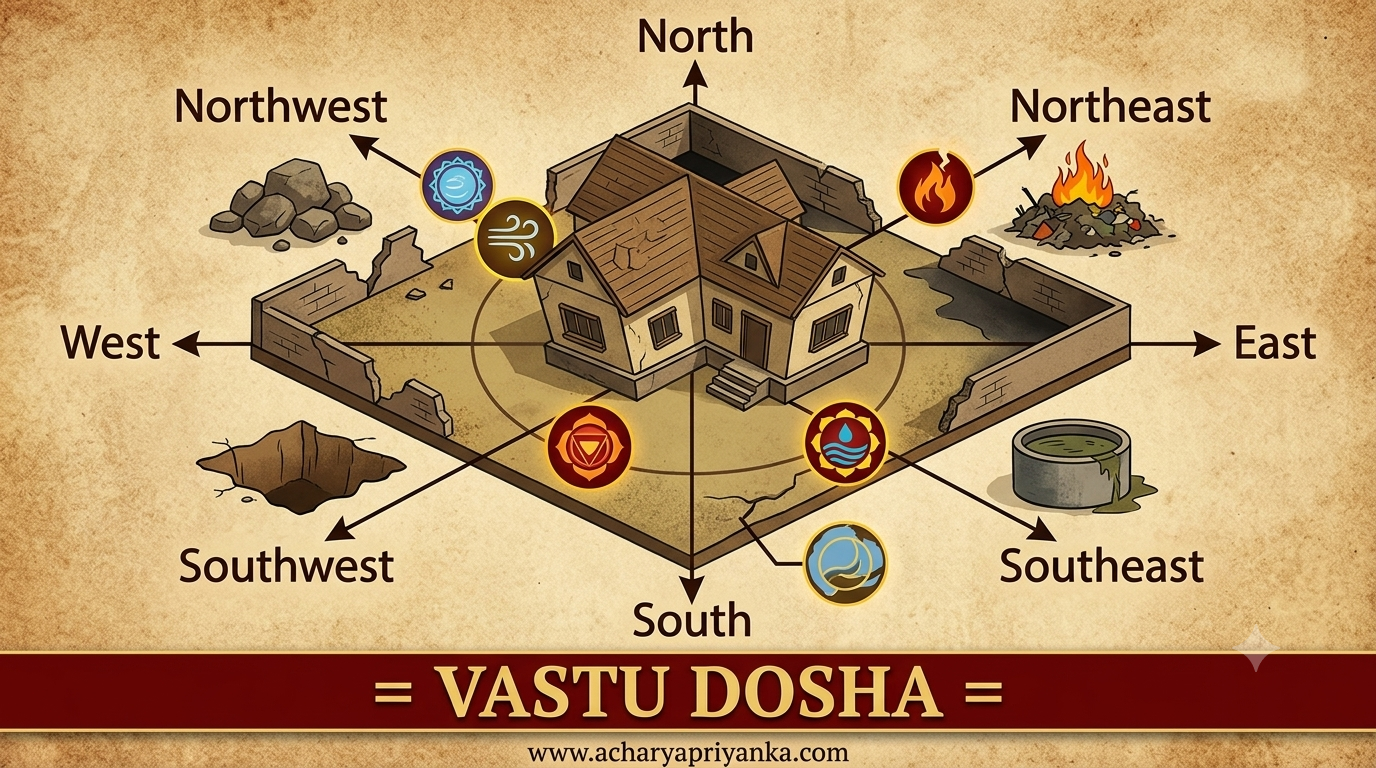
The terms “Vastu defect” and “Vastu imbalance” are often used interchangeably, but there can be a difference in how they are understood. A Vastu defect generally refers to a placement or structural condition that significantly goes against a particular set of Vastu principles. An imbalance may be a comparatively smaller issue involving the use, proportion or representation of a direction or element.
This distinction is important because not every imperfection in a house has the same significance. For example, two houses may have a similar placement of a room, but their complete layouts may be very different. The entrance, surrounding rooms, open and closed areas, levels, natural light and actual use of the space can all change the context.
Therefore, one should be cautious about making a conclusion based on a single feature.
Does Every Vastu Defect Need to Be Corrected?
Not necessarily. If someone discovers that a particular room is not located in the traditionally preferred direction, the first reaction may be to search for a remedy. However, before doing so, it is useful to ask a few basic questions.
How significant is the issue?
Is it a structural problem or simply a matter of preference?
What is the actual use of the space?
Are there other features in the house that influence the same area?
Is the proposed correction practical?
And most importantly, is the remedy addressing a genuine concern or is it being added simply because every Vastu imperfection is assumed to need correction? Vastu is traditionally concerned with the relationship between built space and different directional and elemental principles. That does not necessarily mean that every house must be modified until every traditional guideline is followed perfectly. In an existing home, especially, compromises are often unavoidable.
The Reality of Existing Homes
Vastu principles can be easier to incorporate when a house is being designed from the beginning. An architect or homeowner can consider the layout before construction starts. The situation is very different when someone is already living in a completed house.
Moving a kitchen may mean changing plumbing and electrical connections. Altering a staircase can involve major construction. Changing an entrance may not even be possible in an apartment. In a rented property, structural changes are usually out of the question. This is why the approach to an existing property should be different from the approach to a new construction.
A correction does not always have to mean breaking walls or changing the entire floor plan. Sometimes the practical question is not, “How can I make this house perfect according to Vastu?” but rather, “What is the most appropriate correction that can realistically be made in this space?” That is a much more useful way of looking at the subject.
Assess the Whole Space Before Choosing a Remedy
One of the common mistakes in Vastu discussions is examining a single feature without considering the complete floor plan. Suppose a kitchen is located in a direction that is traditionally considered less suitable. That information alone does not tell us everything about the property.
We also need to understand the position of other rooms, the entrance, the central area, the placement of utilities, the way the kitchen is used and the overall arrangement of the house. Similarly, a bedroom, staircase or toilet should not necessarily be judged only by its direction in isolation. A complete assessment gives context to an individual placement. This is particularly important because remedies are not meant to become a substitute for understanding the actual issue.
Structural Correction and Remedial Correction
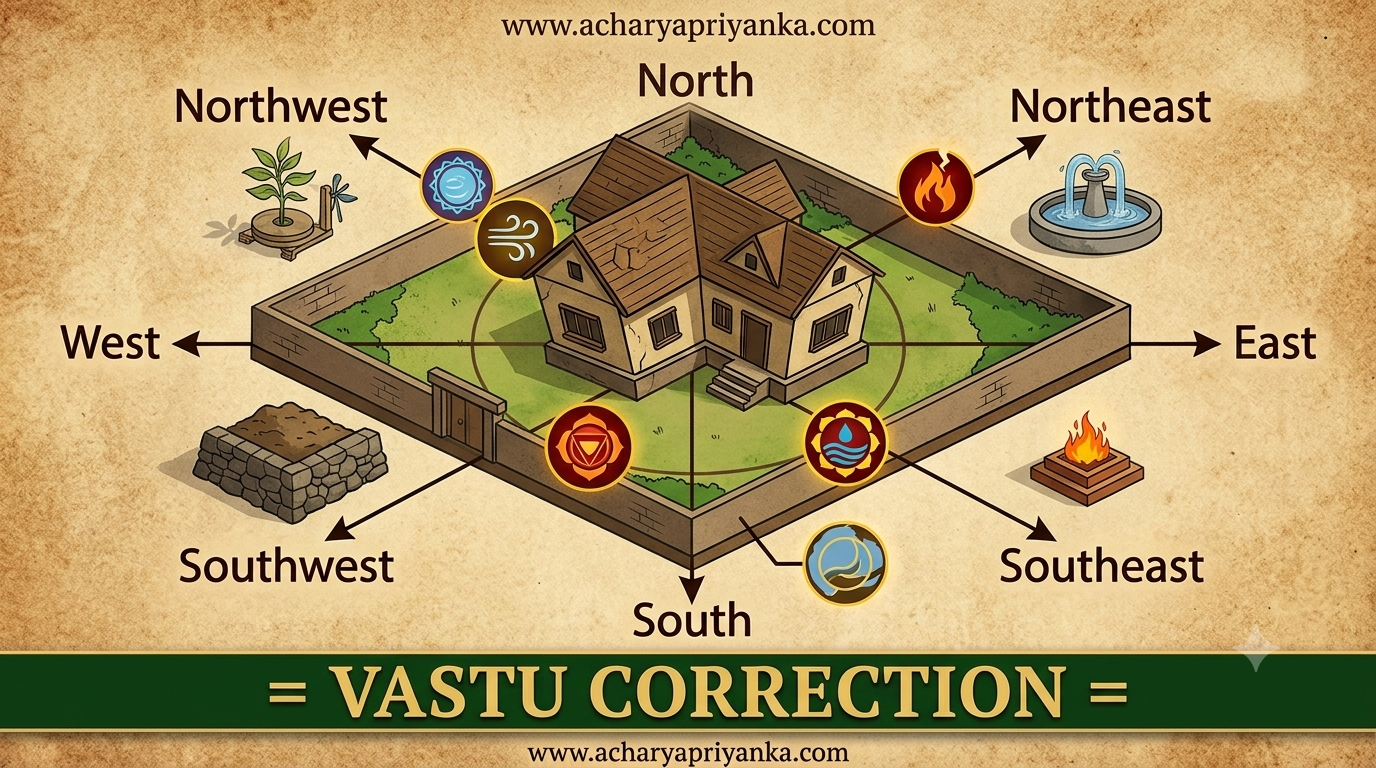
There can be a meaningful difference between correcting the space itself and using a remedy for an existing condition.
A structural correction changes the physical arrangement of the property. Depending on the situation, this could involve changing a room, entrance, staircase or other permanent feature. A remedial correction works within the existing structure.
For someone constructing a new house, structural planning may be possible. For someone living in an apartment or rented accommodation, a practical remedial approach may be more realistic. Neither approach should automatically be treated as the answer in every situation. The appropriate choice depends on the property and the nature of the concern.
When a Remedy May Be Worth Considering
A remedy may be considered when a particular Vastu concern is significant but making a structural change is not practical. This can happen in an already constructed house, an apartment, an office or a rented property.
In such cases, the aim should be to make a considered adjustment rather than adding as many remedies as possible. The remedy should have a clear reason behind it.
For instance, if a particular area is being assessed as weak or unsuitable according to the Vastu framework being followed, the correction should relate to that specific observation. It should not simply be another object placed in the room because someone has suggested that it is generally beneficial.
This distinction matters. A remedy selected for a particular situation has a different purpose from a collection of remedies that have been gathered from different sources without understanding how they relate to each other.
More Remedies Do Not Always Mean Better Vastu
There is a tendency to believe that if one remedy is useful, several remedies must be even better. That is not necessarily the case.
A room may end up containing mirrors, crystals, pyramids, yantras, colours, metals and several other objects, each recommended for a different reason. Instead of creating clarity, this can make the approach confusing. Vastu correction should ideally be purposeful.
If there is a genuine concern, identify it first. Then consider what type of correction is appropriate. There is little value in treating every available remedy as necessary. The quality of an approach cannot simply be measured by the number of remedies used.
What About a Kitchen in an Unfavourable Direction?
The kitchen is a good example of why context matters. Fire-related activity is traditionally given importance in Vastu, and certain directions are generally preferred for a kitchen. Because of this, a kitchen placed elsewhere is often immediately described as a Vastu defect. But before recommending a correction, it is worth looking at the complete kitchen and floor plan.
How is the kitchen positioned within the house?
What is around it?
How is the space being used?
What are the practical possibilities for changing it?
Is the property already constructed?
Can any meaningful structural change actually be made?
If moving the kitchen is impossible, it does not mean the homeowner has no options. It simply means the approach needs to be practical and proportionate to the situation.
Vastu for Rented Homes Requires a Different Approach
Rented properties are an especially good example of why rigid Vastu advice can become impractical. A tenant cannot usually change the entrance, demolish a wall or relocate a staircase. Even changing a kitchen may not be permitted.
In such circumstances, it is more sensible to focus on changes that are reversible and realistically possible. This may include the way certain spaces are used, the organisation of the room, placement of furniture and other appropriate adjustments based on the specific Vastu assessment.
The objective should not be to create anxiety over things that cannot be changed. A Vastu approach should work with the reality of the property rather than ignoring it.
Avoid Fear-Based Vastu Advice
Another important issue is the language used while discussing Vastu defects. Statements such as “This placement will definitely cause problems” can create unnecessary fear, particularly when they are based on one isolated feature.
Traditional Vastu interpretations can be discussed seriously without presenting every deviation as a guaranteed cause of financial, relationship, professional or health-related problems.
There is also a difference between saying that a particular placement is considered unsuitable according to traditional Vastu principles and claiming that it will definitely produce a specific event in someone’s life.
The first is a description of a traditional framework. The second is a much stronger claim and should not be made casually. Vastu consultation should ideally help a person understand their space, not make them afraid of living in it.
A Better Way to Approach Vastu Remedies
Instead of asking, “What remedy should I use?” a better starting point can be:
What exactly is the concern?
Then move through a simple process:
Observe → Assess → Prioritise → Correct → Reassess
First, observe the property as a whole. Next, assess the relevant Vastu factors instead of focusing on one isolated point. Then prioritise. Not every observation has equal importance, and not every issue needs immediate action. After that, choose a correction that is appropriate and practical for the property. Finally, reassess the space rather than continuously adding new remedies. This approach also helps prevent unnecessary changes.
Vastu Is Not About Creating a Perfect House
An important point often gets lost in discussions about Vastu: an existing home will rarely follow every traditional guideline perfectly. Real homes are designed around many considerations—budget, plot size, construction limitations, family requirements, architecture, regulations and convenience.
Therefore, expecting complete perfection may not be realistic. The purpose of studying Vastu can instead be to understand the relationship between the different parts of a space and identify areas where a meaningful adjustment may be possible. A small, well-considered correction can be more sensible than a large number of unrelated remedies.
Wrapping Up
Not every Vastu imbalance needs to become a reason for concern, and not every deviation necessarily calls for a remedy. The more useful question is not simply whether a defect exists, but how significant it is within the context of the entire property.
A thoughtful Vastu approach considers the floor plan, directions, usage of spaces, structural possibilities and practical limitations before suggesting a correction. Remedies can have a place in Vastu, particularly when structural changes are not possible. But they should be selected with a clear purpose rather than used automatically.
Good Vastu is not necessarily about making every corner of a house conform perfectly to every guideline. It is about understanding the space as a whole and making corrections where they are genuinely relevant and practically possible. Sometimes, the most sensible Vastu remedy may be a change. And sometimes, it may simply be understanding the space correctly before deciding to change anything.